
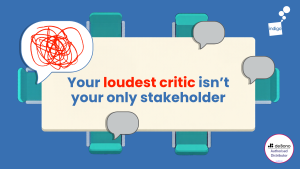
 Most projects have at least one difficult stakeholder. The person who questions the timeline, picks holes in the plan and replies to your update with three paragraphs of concerns.
But you know that, and you are prepared for them, with extra slides, well-rehearsed answers and constantly thinking about them on the drive home.
Meanwhile, the people who quietly support you, or haven’t made up their minds yet, hear from you once a month.
Critics do need attention, and some of their objections will be worth hearing. But if one person is taking up most of your time, the rest of your stakeholders are probably getting less of your focus than they should.
Why critics take up so much of our attention
Part of it is how we’re wired. In their review of psychological research, Roy Baumeister and colleagues found that negative experiences generally have a stronger impact than positive ones. It helps explain why one critical comment can stay with you for days, while three people who said “looks good” are forgotten by lunchtime.
Critics are also hard to miss. They raise objections, ask for more information and say what they think. You can see their concerns, even if you don’t always know what’s driving them.
Supporters are quieter. It’s easy to assume they’re fine.
So you start to think that if you can just win the critic over, everything else will fall into place. You give them another meeting, another explanation, another look at the plan.
And everyone else waits.
What it costs when one voice gets too much attention
When most of your energy focuses on your loudest critic, other relationships suffer.
- Supporters get taken for granted. The people who want the project to succeed get fewer of the updates and conversations that keep them involved.
- Undecided stakeholders hear mostly about problems. If your time goes on answering objections, there’s less left for explaining why the project matters to the people still making up their minds.
- Quieter team members say less. When the same one or two voices fill every meeting, others may decide there’s little point in trying to be heard.
- Decisions bend around one opinion. Changes get made to keep the most persistent person happy, not because they’re right for the project.
Before long, you’re managing reactions instead of moving the project forward.
Difficult stakeholders aren’t always wrong
None of this means ignoring people who challenge you. A difficult stakeholder might raise a fair concern, spot a risk you’ve missed or ask the question nobody else wanted to. The trick is to separate what someone says from how much attention they demand. Listen, understand the concern and decide what action, if any, is needed. Give it the attention it deserves, then return to the wider project.
The person who speaks most often doesn’t necessarily have the most important view, and winning them over shouldn’t become the whole job. Your job is to understand the full range of views around the project and get the right people involved at the right time.
One thing to try in your next meeting
Next time you’re in a project meeting, notice who speaks, whose points get picked up and whose opinions end up shaping the decision. If one person has raised several objections and it’s turning into a two-way debate, pause and ask the room:
“Does anyone see it differently?”
It’s a simple question, but it gives quieter people a way in. You might hear a perspective you hadn’t considered, uncover a problem nobody had mentioned, or find there’s more agreement in the room than you thought.
If nobody answers, ask someone directly: “Sarah, you’ve been working closely with the team on this. What’s your view?”
The critic still gets heard. So does everyone else.
When one voice takes over the room
Meetings tend to drift towards whoever is most confident, most persistent or most senior. Without a clear way to explore different views, a discussion can quickly turn into a debate, with people defending their positions instead of looking at the issue properly.
Six Thinking Hats® is one technique that helps here. Instead of having people defend competing opinions, it gives everyone a shared way to think a problem through, so they look beyond their first reactions and explore it more fully. People won’t always agree at the end, but they’ll have considered a wider range of views before deciding.
Learn to handle difficult stakeholders with confidence
Handling stakeholders well takes more than answering objections. You need to know who’s involved in your project, what matters to each of them and how best to approach them.
Our Stakeholder Engagement workshop helps you identify your stakeholders, build those relationships, handle challenging conversations and get support for your project. It includes an AI-powered business simulation where you work with realistic virtual stakeholders who react to the decisions you make and the conversations you have, so you can practise and see the effect of your approach.
If your meetings are often dominated by strong opinions, our Six Thinking Hats® workshop gives your team a practical method for thinking through issues together, exploring alternatives and making better-informed decisions.
Both run as public workshops, where you’ll learn alongside people from other organisations, or as in-house training for your team.
Not every stakeholder needs the same amount of your time. But the right people should get the attention they need, and the loudest voice shouldn’t set the agenda.
Related reading
- Stakeholders who don’t know you don’t like you (yet)
- It’s rarely the plan. It’s usually the people.
- Baumeister paper: https://doi.org/10.1037/1089-2680.5.4.323
Frequently asked questions
How do you deal with difficult stakeholders?
Start with what’s behind their concerns. Are they worried about the impact on their team, the resources needed or the risks? Listen, ask questions and respond to the issue rather than the tone. Then agree how and when you’ll keep them involved.
Should you ignore difficult stakeholders?
No. A challenging stakeholder may raise real issues or spot risks others have missed. Take their concerns seriously, but don’t let them take up a disproportionate amount of your time or dictate every decision.
Why do difficult stakeholders take up so much time?
Negative feedback tends to affect us more than positive feedback, and a vocal critic is harder to overlook than someone who quietly supports the project. Together, that can leave people running projects spending more time answering objections than building relationships with everyone else.
How do you stop one person dominating a meeting?
Set clear expectations for participation, and ask other people for their views, especially when a discussion turns into a debate between two people. A simple “Does anyone see it differently?” often helps. A structured approach such as Six Thinking Hats® can also help a group look at an issue from different angles, rather than following the loudest voice.
Can you learn to handle difficult stakeholders?
Yes. Stakeholder engagement is a skill, and it improves with practical training and experience. Learning how to understand what stakeholders need, handle challenging conversations and adapt your approach makes a real difference. Practising in realistic situations also builds confidence before you face the same challenges on your own projects. Learn how to identify, understand, engage and manage your stakeholders.