
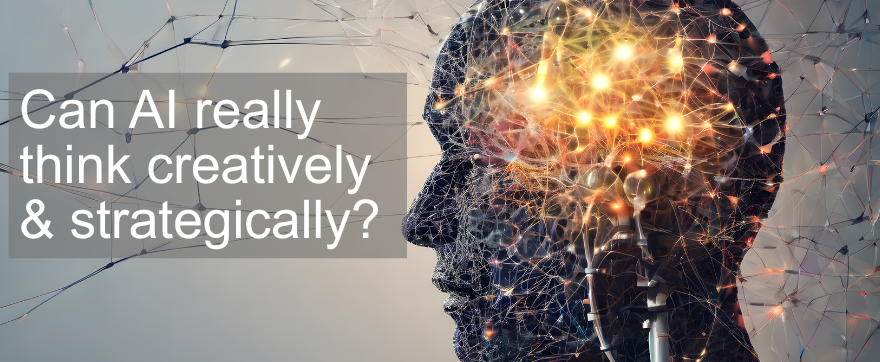
There’s a version of the AI conversation that goes like this: AI will automate the routine, freeing humans to focus on the creative and strategic work that really matters.
It’s an attractive idea. The problem is that most organisations don’t actually have a plan for what happens when the routine disappears. They assume the creative and strategic thinking will follow naturally. It won’t.
The pattern problem
AI is genuinely remarkable at processing existing information: finding patterns, generating variations, extrapolating from what’s already there. But that’s also its fundamental constraint. It derives everything it produces from what already exists. It remixes, recombines and completes patterns with extraordinary sophistication..
What it cannot do is challenge the pattern itself.
Edward de Bono described this decades before AI entered the conversation. He called it the “intelligence trap”, the tendency of capable thinkers to use their ability to defend and elaborate existing positions, rather than to question whether those positions are right in the first place. High intelligence applied within established patterns. Efficient, coherent, and frequently wrong.
AI has that trap built in by design.
The implications for business are significant. When you and your competitor’s train your AI with the same information and optimise them against the same patterns, as a result the thinking that creates real advantage happens elsewhere – in the space AI can’t reach.
What that space looks like
Genuinely new ideas don’t come from recombining the existing, they come from:
- Deliberate disruption of the patterns we’ve stopped noticing.
- Asking whether we’re solving the right problem, not just solving it better.
- The willingness to follow a line of thinking into uncomfortable territory, without knowing where it leads.
And they come from groups of people who can think together well, which is harder than it sounds.
Most meetings are an expensive collision of different thinking modes happening simultaneously. Someone is arguing facts; someone else is expressing concern; a third person is trying to generate ideas while a fourth is shutting them down with risk analysis. Nobody is wrong to be thinking what they’re thinking. But the collision produces less than any individual would manage alone.
Structured thinking, knowing which mode to be in and when, changes that dynamic entirely. It’s not a soft skill. It’s a design problem and it has design solutions.
The question worth sitting with
Here’s a useful exercise. Take a significant strategic challenge your organisation is facing and run it through an AI tool. Ask for analysis, frameworks, options. Read what it produces carefully.
Then ask: what is this missing? What assumptions is it not questioning? What would a genuinely creative thinker see that this didn’t?
That gap between what AI produces and what rigorous human thinking adds is worth understanding. Because closing it is not about working harder or hiring smarter. It’s about having methods: for generating ideas that break with existing patterns, for evaluating them without killing them too early, and for getting groups of people to think together rather than past each other.
De Bono’s work: Lateral Thinking, Six Thinking Hats® and the Course in Creativity™ was built specifically to address these problems. Not as creativity exercises, but as structured business methods. That distinction matters.
The longer view
The organisations that navigate the next decade well won’t simply be those that use AI most effectively. They’ll be those whose people can do what AI cannot: challenge the premise, see what nobody else has seen, and think together toward something genuinely new.
That’s not a technology problem. It’s a human capability problem and unlike most capability gaps, this one is entirely solvable.
Indigo Business Services is the exclusive UK distributor for Edward de Bono Limited and delivers Six Thinking Hats®, Lateral Thinking and the Course in Creativity™ face-to-face and online.