
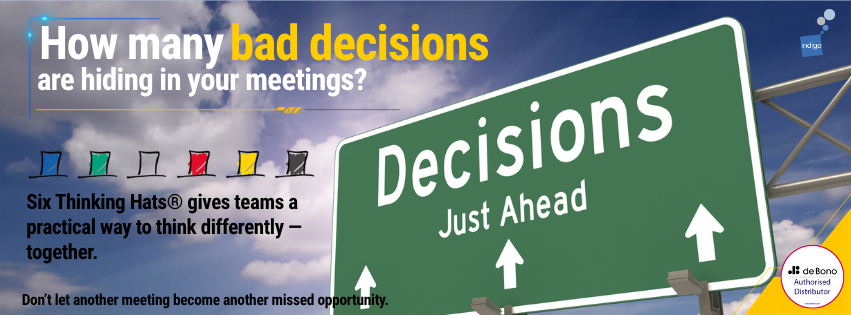
 Not every bad decision looks bad when it’s made. Some are nodded through because the meeting is running out of time. Some happen because the most confident person in the room sounds more certain than everyone else. Others are agreed because nobody wants to reopen a discussion that appears to have reached a conclusion.
The decision gets made. Everyone moves on.
Then, a few weeks later, someone says: “Why didn’t we think of that?”
The problem isn’t always the decision itself. Often, it’s the thinking process that produced it. If your meetings regularly involve groupthink, circular debate, decisions made under pressure or important issues that only emerge after the meeting, the answer isn’t necessarily to have more meetings or involve more people. It’s to structure how people think together.
That’s what Six Thinking Hats® is designed to do.
Why do teams make bad decisions in meetings?
Groups don’t automatically make better decisions simply because more people are involved. In an unstructured meeting, people tend to think about different things at the same time. One person is looking for risks. Another is defending the idea. Someone else is thinking about the budget. Another is already considering how people will react. The result can sound like this:
- “I think we should go ahead.”
- “I’m worried about the cost.”
- “But the benefits are significant.”
- “What happens if the client doesn’t like it?”
- “We’ve already tried something similar.”
- “Can we just make a decision? We’re already over time.”
All of those contributions might be valid. The problem is that the group isn’t thinking together.
People are often responding to each other rather than systematically examining the decision. This can lead to:
- Groupthink, where people converge on an answer too quickly.
- Confirmation bias, where people give more weight to information that supports what they already believe.
- Hierarchy-driven decisions, where senior or confident voices carry disproportionate influence.
- Premature criticism, where an idea is rejected before its potential has been properly explored.
- Missed alternatives, because the group spends its time debating the first option rather than generating others.
- Circular discussion, where the same arguments keep returning without moving the decision forward.
The people in the meeting may be capable, experienced and intelligent. The problem is normally the process.
How can you make better decisions in meetings?
The answer isn’t simply to ask people to “think more carefully”. A better approach is to give the group a structure that deliberately separates the different types of thinking a good decision requires. Before reaching a decision, a team needs to consider questions such as:
- What do we know? What are the facts? What information is missing? What assumptions are we making?
- What could go wrong? What are the risks, weaknesses and potential consequences?
- What could go right? What are the benefits, opportunities and positive outcomes?
- What else could we do? What alternatives haven’t we considered? Is there a better way?
- What is our reaction? What does our instinct tell us? How do people feel about the options?
- What thinking do we need to do next? Have we explored the issue properly? What have we learned? What decision needs to be made?
The challenge is doing all of this without turning the meeting into a series of competing arguments. This is where Six Thinking Hats® provides a practical solution.
How does Six Thinking Hats® improve decision-making?
Developed by Dr Edward de Bono, Six Thinking Hats® gives teams a simple structure for looking at an issue from different perspectives. Each hat represents a different mode of thinking:
- White Hat – Information – What do we know? What information do we have and what do we need?
- Red Hat – Feelings – What is our instinctive reaction? What do we feel about the situation?
- Black Hat – Caution – What are the risks? What could go wrong? What should we be cautious about?
- Yellow Hat – Benefits – What are the benefits? What could work? What opportunities could this create?
- Green Hat – Creativity – What alternatives are possible? What new ideas or approaches could we explore?
- Blue Hat – Process – What are we trying to achieve? What thinking needs to happen? What should we do next?
The important part isn’t simply having six categories. It is that the whole group uses the same hat at the same time. This is known as parallel thinking.
Instead of one person saying “I see the benefits” while another says “I see the risks” and a third says “I don’t like the idea”, everyone looks at the same aspect of the issue together. The group isn’t arguing about which perspective is right, they are deliberately exploring all of them.
How does Six Thinking Hats® prevent groupthink?
Groupthink often happens when a team reaches apparent agreement before it has properly explored the alternatives.
Once an idea starts to gain momentum, people can become reluctant to challenge it. A concern might go unspoken, an alternative might never be suggested or a less confident colleague might assume everyone else has already made up their mind. Six Thinking Hats® changes the structure of the conversation.
If the group is wearing:
- the Black Hat, everyone has permission to look for risks,
- the Green Hat, everyone has permission to generate alternatives or the
- Yellow Hat, everyone is deliberately looking for benefits and opportunities.
That means challenging an idea doesn’t have to mean arguing against it.
The method gives challenge a place in the process.
And that is one of the key skills participants develop when they learn Six Thinking Hats®: how to contribute different perspectives without turning every difference of opinion into a debate.
What happens when you learn to use the Six Hats?
Knowing the names of the six hats isn’t enough. The real value comes from learning how and when to use them.
In a Six Thinking Hats® workshop, participants practise applying the different thinking modes to real situations. They learn how to move a discussion from one type of thinking to another, how to stop one mode of thinking dominating the conversation and how to use the method to structure meetings and decision-making.
That changes what happens in the room.
Instead of: “I don’t agree.”
Participants can learn to think: “Let’s look at this through the Black Hat.”
Instead of: “That’s a terrible idea.”
The response becomes: “Let’s explore the risks, then deliberately look for what could work.”
Instead of: “We’ve already decided.”
The team can ask: “Have we done the thinking we need to do before we decide?”
The difference is subtle but important. The method doesn’t try to make everyone agree. It helps teams think more productively before they decide.
Does Six Thinking Hats® make meetings longer?
Not necessarily. The purpose isn’t to add more discussion. It is to make the discussion more focused.
Unstructured meetings can spend considerable time moving backwards and forwards between the same arguments. A structured thinking process can help the group focus on one aspect at a time, then deliberately move on.
The aim is not: More meeting.
It is: Better thinking in the meeting.
That is why learning the method matters. A team that understands Six Thinking Hats® can use the framework when it matters most: when a decision is complex, important, contentious or easy to rush.
What can better decision-making change?
For
- Leaders, a structured approach reduces the influence of hierarchy, personality and confidence on the quality of the discussion.
- Teams, it makes challenge more constructive, create space for quieter perspectives and reduce circular debate.
- Organisations, it helps reduce the number of decisions that have to be revisited because an important risk, alternative or piece of information was missed the first time.
But the biggest change is often simpler: people leave the meeting knowing that the decision has actually been thought through. Not necessarily that everyone agrees.Not necessarily that the decision will definitely succeed. But that the group has deliberately examined the issue from different perspectives before deciding what to do.
The problem isn’t that your team can’t think. It’s that you may not be thinking together.
If your meetings regularly produce:
- decisions that are revisited a few weeks later,
- ideas that get rejected before they’ve been explored,
- discussions dominated by the most senior or confident person,
- risks that appear only after the decision has been made,
- arguments that go round in circles, or
- apparent agreement that nobody really feels comfortable with.
You may not have a people problem. You may have a thinking process problem and Six Thinking Hats® gives teams a practical way to address it.
But the method is something you need to learn and practise, not simply read about. In a Six Thinking Hats® workshop, participants learn how to use the six thinking modes, practise switching between them and apply the approach to the kinds of decisions, problems and meetings they face at work.
The result isn’t a meeting technique that someone remembers for a week and forgets. It’s a shared language for thinking together.
- “Let’s put on the Black Hat.”
- “We haven’t done the Green Hat yet.”
- “What do we know for certain?”
- “Let’s separate our reaction from the facts.”
Those phrases can change the conversation because everyone knows what they mean.
Try Six Thinking Hats® before you buy it
If you want to see how the method works before committing your team to a workshop, you can experience it for yourself in a free 45-minute live, interactive Six Thinking Hats® demo.
Six Thinking Hats® Demo
See how Six Thinking Hats® changes the way a team thinks, challenges ideas and makes decisions – and why learning the approach is different from simply being told to “consider different perspectives”.
- Wednesday 14 October 2026 | 14:00–14:45 BST | Microsoft Teams
Reserve a place for your team →
If your meetings keep producing decisions that need to be revisited, challenged or quietly undone, don’t just ask whether your team made the wrong decision. Ask whether they had the right thinking process to make it.
ABOUT INDIGO AND EDWARD DE BONO
Indigo Business Services is the exclusive UK distributor for Edward de Bono Limited. We run the full suite of de Bono creative thinking workshops, including Lateral Thinking, Six Thinking Hats® and Course in Creativity™, helping teams generate better ideas and make stronger decisions.