
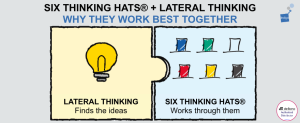
 Six Thinking Hats® and Lateral Thinking are two of Dr Edward de Bono’s best-known tools, and people often treat them as alternatives. Combined, they cover both halves of a good decision: generating ideas worth considering and deciding which ones to pursue.
Most teams struggle with one half more than the other. Some run out of options and keep returning to the first idea that seems to work. Others have plenty of ideas and no sensible way to choose between them, so the discussion turns into a contest. Six Thinking Hats® and Lateral Thinking each tackle one of those problems, and each is stronger with the other. That is why we offer them together in our Course in Creativity™.
What Lateral Thinking gives you
Lateral Thinking gives teams a set of practical techniques to generate new ideas and challenge the way a problem is framed. Our guide, What is Lateral Thinking?, covers the basics. In practice, it gives you:
- A way past the first idea. Most of us stop at the first answer that works. Lateral Thinking gives you tools to keep going and find better ones.
- The habit of challenging assumptions. Unquestioned assumptions stall problems. Lateral Thinking exposes them.
- Techniques to generate ideas on demand. Use the techniques deliberately, so your team never has to wait for inspiration or for the one person who is “good at ideas”.
- A way toshape rough ideas into something usable.Take a half-formed suggestion and develop it before anyone writes it off in the first minute.
That matters even more now that AI can produce ideas in seconds. The skill is in challenging, developing and choosing, as we explain in AI can give you lots of ideas. Challenge, develop and pick the right one with Lateral Thinking.
What Six Thinking Hats® gives you
Six Thinking Hats® gives a team a shared structure for looking at an issue from one perspective at a time: facts, feelings, risks, benefits, new ideas and managing the process. Our guide, What is Six Thinking Hats®?, explains each hat. In practice, it gives you:
- Meetings that stay on track. When everyone looks at the same perspective together, the discussion stops pulling in six directions at once.
- Less arguing and more exploring. Nobody has to defend a position, which is the idea behind parallel thinking®.
- Every voice heard. Quieter people get a proper turn, and risks can be raised without anyone feeling attacked.
- Better-tested decisions. Benefits and risks both get a full hearing, in an order the team chooses on purpose.
Six Thinking Hats® and Lateral Thinking at a glance
The two tools answer different questions, which is why they fit together so well.
| Lateral Thinking | Six Thinking Hats® | |
| The question it answers | What else could we do? | How do we think this through together? |
| What it gives you | New ideas, fresh angles and a way to challenge assumptions. | A shared structure for looking at an issue one perspective at a time. |
| Where it helps most | Stuck on the first idea, or short of options. | Meetings that argue, stall or go round in circles. |
| What you take away | Techniques you can use to generate and develop ideas on demand. | A way to run discussions and make better-tested decisions. |
Why Six Thinking Hats® and Lateral Thinking work better together
Each tool covers a gap in the other.
Lateral Thinking on its own can leave a team with a pile of new ideas and no agreed way to examine them. Where unusual suggestions get dismissed by the loudest voice, or admired and then forgotten. Six Thinking Hats® on its own can give a team a beautifully organised discussion of the same old options. A well-run meeting still needs something worth discussing.
Together, they give a team techniqies to widen the options and a process to work through them. Lateral Thinking gives the team more to work with. Six Thinking Hats® gives the team a way to work through it.
Example of how it looks: when a team is deciding how to cut customer complaints:
- Set the process. The team agrees the order they will use the hats and how long they will spend on each.
- Start with the facts. What do we know about the complaints, and what do we still need to find out?
- Generate new ideas. The Green Hat is where Lateral Thinking techniques come in, challenging assumptions about the problem and producing options the team wouldn’t reach on its own.
- Look for the value. The team asks what is useful in each idea, including the odd-looking ones, before judging any of them.
- Test the risks. Only then does the team ask what could go wrong with the strongest options.
- Agree the next steps. The process is closed with a clear outcome that everyone leaves with.
The result: a better set of options and better-tested choice – from the same people in the same meeting.
This is the thinking behind our Course in Creativity™, a combined workshop that brings Six Thinking Hats® and Lateral Thinking together.
What you get when you learn both
For the business
- A wider range of options on every important decision.
- Choices that have been properly tested before money and time are committed.
- Less reliance on one or two “creative” people to keep ideas flowing.
For the team
- A shared language for generating ideas and for discussing them.
- Meetings where new ideas get a fair hearing instead of a quick dismissal.
- Less friction, because disagreement is handled by the process.
For you
- The confidence to find fresh ideas when the obvious ones run out.
- A clear way to lead a discussion and keep it productive.
- Skills you can use on your own decisions as well as in group settings.
ABOUT INDIGO AND EDWARD DE BONO
Indigo Business Services is the exclusive UK distributor for Edward de Bono Limited. We run the full suite of de Bono creative thinking workshops, including Lateral Thinking, Six Thinking Hats® and Course in Creativity™, helping teams generate better ideas and make stronger decisions.
Frequently asked questions
Do I need to learn both?
No. Each can be used on its own and each brings clear benefits. Combine Six Thinking Hats® and Lateral Thinking for a way to find ideas and how work through them, which is where the two reinforce each other.
Is there a workshop that covers both?
Yes. The Course in Creativity™ workshop combines Six Thinking Hats® and Lateral Thinking, so you learn both tools and how they fit together.
Which should we start with?
Start with the problem you recognise most. If your team keeps settling on the first idea or runs out of options, begin with Lateral Thinking. And if meetings are full of arguement, they stall or go round in circles, begin with Six Thinking Hats®.
Are they only for creative roles?
No. They are skills for thinking, and any team that makes decisions can use them, whatever its function.
Does AI make these skills less important?
It makes them more important. AI can generate a long list of ideas quickly, and someone still has to challenge them, develop the promising ones and choose between them. These two tools help with exactly that.
Can we train our team in-house?
Yes. Both programmes can be run for your own team, and can be tailored to the decisions and challenges you face. You can find out more about our in-house options below.
Ready to learn Six Thinking Hats® and Lateral Thinking?
Public workshops are open to individuals from any organisation, groups and teams can be trained through our in-house options. Course in Creativity™ combines both workshops together.
- Course in Creativity™ (Six Thinking Hats® and Lateral Thinking together): indigobusiness.co.uk/Workshop/de-bonos-course-in-creativity
- Six Thinking Hats® workshop: indigobusiness.co.uk/hats
- Lateral Thinking workshop: indigobusiness.co.uk/Workshop/de-bonos-lateral-thinking
- In-house training: indigobusiness.co.uk/in-house
More ideas. Better decisions. Both skills, one team.
Indigo is the exclusive UK distributor for Edward de Bono Limited, bringing his practical creative thinking workshops to UK businesses.