
 A good argument feels like progress. Voices get raised, points get scored, someone “wins”. It looks like a team that cares. But, Parallel Thinking®, where everyone looks in the same direction at once, usually leads teams to better decisions.
Yet when the meeting ends, ask what the team actually discovered. Usually, very little. Everyone defended the view they walked in with, and the decision went to whoever argued best, not to the best idea.
Most of us were taught to think together by arguing. It’s also one of the least effective ways to do it.
Why arguing is a poor way to think together
In an argument, the goal is to be right. That changes how people behave.
- People defend instead of explore. Once someone has taken a position, every new piece of information becomes ammunition for it or a threat to it.
- Good points from the “other side” get ignored. Admitting the opponent has a fair point feels like losing, so useful insights are left on the table.
- Ideas get judged before they’re understood. People attack a suggestion in its first sentence, before anyone has seen what it could become.
- The best arguer wins, not the best answer. Confidence, seniority and stamina decide the outcome more often than the evidence does. We look at this in more detail in The loudest person in the room isn’t always right.
The cost is real. For the business, it means slower decisions and choices that haven’t been properly tested. For the team, it means winners, losers and lingering friction after the meeting ends. And for individuals, it means energy spent on point-scoring rather than thinking, and a habit of keeping quiet to avoid the fight.
From debate to Parallel Thinking®
Dr Edward de Bono saw adversarial argument as one of the biggest limits on how groups think. His answer was Parallel Thinking®, and Six Thinking Hats® is how teams put it into practice. If you’re new to the method, our plain-English guide, What is Six Thinking Hats®?, explains the six hats and what each one is for.
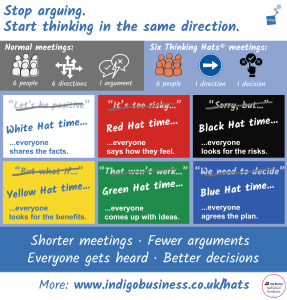
Instead of two sides facing each other, everyone faces the same way. The whole team looks at the issue from one perspective at a time, together. Nobody is defending a position, so there is nothing to win. The only goal left is to see the issue as fully as possible.
Take a team deciding whether to launch a new service. In an argument, one side lists the reasons to go and the other lists the reasons to stop, and each defends their corner. With Parallel Thinking®, the whole team spends a few minutes on the facts together, then on the benefits together, then on the risks together. Same people, same issue, but nobody is defending a position, so the benefits and the risks both get a proper look.
That shift changes the feel of a meeting. Disagreement stays, and it stops being a contest. A concern becomes something the team examines together, and a bold idea gets room to develop before it is judged.
The hats themselves are quick to learn. Knowing how to combine them for different situations is the skill that turns a good idea into a real change, and that is what the workshop is built around.
What changes when teams use Parallel Thinking®
For the business
- Decisions based on the whole picture, not on who argued hardest.
- Less time lost to re-opening decisions that never had real buy-in.
- A team that tests ideas thoroughly without tearing them down.
For the team
- No winners and losers, so less friction carried into the next meeting.
- Room for challenge without anyone feeling attacked.
- A shared way of working that makes it easier to agree how to disagree.
For you
- Less energy spent defending your position, more spent on the problem.
- The freedom to change your mind without it feeling like a defeat.
- Meetings where you can say what you see, not what wins the point.
ABOUT INDIGO AND EDWARD DE BONO
Indigo Business Services is the exclusive UK distributor for Edward de Bono Limited. We run the full suite of de Bono creative thinking workshops, including Lateral Thinking, Six Thinking Hats® and Course in Creativity™, helping teams generate better ideas and make stronger decisions.
Frequently asked questions
Isn’t a bit of healthy debate a good thing?
Challenge is essential. The problem with debate is that it turns challenge into a contest. Parallel Thinking® keeps all the challenge but removes the need to win, so concerns get a full hearing instead of being used to score points.
Won’t stopping the arguing mean everyone just agrees?
No. The aim is a well-tested decision. Risks and objections still get raised, often more thoroughly than before, because they’re examined by the whole team rather than defended or dismissed by one side.
My team doesn’t argue, they just go quiet. Is this still relevant?
Yes. Silence is often the other side of argument: people hold back because speaking up means getting drawn into a fight. When there’s nothing to win or lose, it becomes much easier to contribute.
Does it work when the most senior person has already made up their mind?
It helps. Because everyone looks at the same perspective together, a senior view gets examined like any other, without anyone having to openly challenge the boss.
Can we use it for one-to-one conversations, not just group meetings?
Yes. Parallel Thinking® works with two people as well as twenty, and many people also use it to think through their own decisions.
Ready to try Parallel Thinking®?
On our Six Thinking Hats® workshop, you’ll learn the sequences that turn the hats from a neat idea into a tool your team uses every week. You’ll practise on real challenges and leave ready to run your next meeting differently.
Not sure yet? See it in action first. Join our free, live demo on Wednesday 14 October, 14:00-14:45 on MS Teams, and see Parallel Thinking® at work.
- Book your free demo place: indigobusiness.co.uk/sth-demo
- Find out more about the workshop: indigobusiness.co.uk/hats
Six people. One direction. Better decisions.