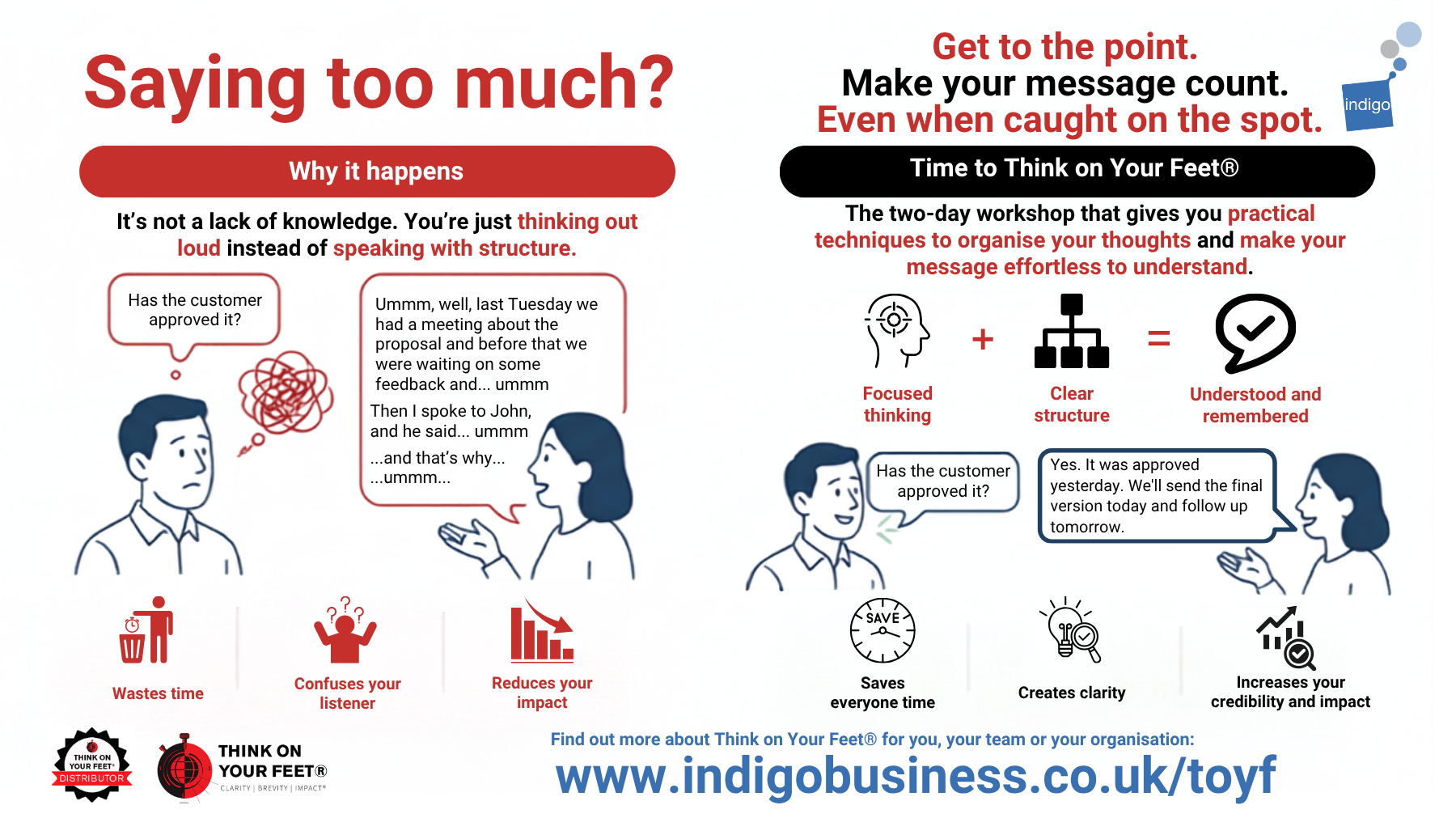

 The three seconds that decide how you’re remembered

Someone asks you a question in a meeting that you didn’t see coming. For a moment, nothing comes out.
You fill the silence with “um…”, start talking before you’ve decided what you’re trying to say, or promise to come back with an answer later. The silence probably lasts no more than three seconds. It doesn’t feel like much, but it can become the moment people remember.
Meanwhile, someone else in the same meeting is asked an equally difficult question. They pause briefly, answer calmly, make their point clearly and stop talking.
It’s easy to assume they’re naturally confident. Or simply better under pressure.
In reality, they’ve developed a skill that most people are never taught: they organise their thinking before they speak, not while they’re speaking. That distinction changes everything.
Why your brain freezes under pressure
If you’ve ever wondered how to think clearly under pressure, the first thing to understand is that freezing isn’t usually a lack of knowledge. It’s a thinking problem.
When you’re put on the spot, your brain is trying to do several demanding tasks at once:
- Understand the question.
- Decide what’s most important.
- Organise your ideas.
- Choose the right words.
- Monitor how you’re coming across.
- Watch everyone else’s reaction.
Trying to do all of that simultaneously creates cognitive overload. That’s why people often ramble, lose their train of thought or start explaining before they’ve worked out the main point.
The people who appear calm under pressure usually aren’t thinking faster than everyone else. They’re thinking in a structure.
Having a simple framework dramatically reduces the mental effort required to organise your response. Instead of searching for what to say next, you already have a reliable way to shape your answer.
That’s one of the biggest differences between sounding confident and simply hoping the right words arrive.
It’s not only about answering difficult questions
The same problem appears much earlier in many meetings.
Perhaps you’ve had a good idea but watched someone else speak first.
Or you’ve left the meeting thinking: “I knew what I wanted to say, I just couldn’t get it out clearly enough.”
The issue often isn’t confidence. It’s that unstructured discussions reward whoever speaks first or loudest, rather than whoever has the strongest contribution. When everyone is thinking and speaking differently, valuable ideas are easily overlooked.
Learning to think clearly under pressure isn’t just about handling difficult questions. It’s also about contributing effectively, making your point with confidence and helping discussions produce better decisions.
How to think clearly under pressure
Like any professional skill, clear thinking under pressure can be developed. It isn’t about becoming more extroverted or learning clever phrases. It’s about giving yourself a repeatable way to organise your thinking.
Think on Your Feet® helps individuals respond clearly when they’re put on the spot. Participants learn practical response structures that make it easier to organise ideas in seconds, rather than trying to build an answer while they’re speaking. Developed by Dr Keith Spicer, the programme has helped more than half a million professionals in over 30 countries communicate more clearly under pressure.
Six Thinking Hats®, developed by Dr Edward de Bono, tackles the problem from a different angle. Instead of discussions becoming dominated by the fastest or loudest voices, everyone explores the same aspect of the problem together before moving to the next. This structured approach creates opportunities for every participant to contribute and often leads to clearer thinking, stronger collaboration and better decisions.
Together, these programmes address both sides of effective communication:
- Thinking clearly when you’re asked to respond.
- Contributing more effectively during discussions before the questions even arrive.
What changes afterwards?
The benefits don’t stop when the meeting ends.
Once you’ve learned how to think clearly under pressure, those skills transfer into interviews, presentations, client conversations, performance reviews, networking events and everyday workplace discussions.
Instead of worrying about what might be asked, you know how to organise your response whatever the situation.
Likewise, learning to participate in structured discussions means your ideas are more likely to be heard, understood and acted upon.
People who consistently communicate clearly aren’t usually the smartest people in the room. They’re often the people with the clearest structure.
See the techniques in action
Reading about structured thinking is one thing. Seeing it used in real conversations is another. That’s why we run free live online demonstrations of both programmes before you decide whether either workshop is right for you.
Upcoming free Microsoft Teams demos
- Six Thinking Hats® – Wednesday 14 October, 14:00–14:45 BST
- Think on Your Feet® – Tuesday 17 November, 14:00–14:45 GMT
Reserve your free place today to experience the techniques for yourself.
Or, if you’d prefer to discuss which programme best suits your role or organisation, get in touch and we’ll be happy to help.