

 Ask a business leader whether AI matters right now and you’ll get an answer before you finish the question. Ask them whether their people are equipped to judge what AI actually produces, and the answer comes much more slowly.
That gap – between adopting the tool and being ready to use it well – is quietly becoming one of the defining workforce challenges of 2026. And the conversation about AI readiness is missing an important distinction. Telling people to think critically isn’t enough. They need a structure for doing it.
The gap nobody’s fixing
A recent survey of HR and L&D leaders found that 56% rank strategic and critical thinking among the most critical capabilities their workforce will need in 2026, ahead of digital fluency at 44% and leadership skills at 42%. Respondents could select up to three skills, making strategic and critical thinking the clear top predicted skill need in the survey.
That matters because strategic and critical thinking aren’t simply another pair of skills to add to an L&D catalogue. They’re part of the infrastructure people need to navigate increasingly complex, AI-enabled work. Without them, leadership development can produce managers who execute but struggle with ambiguity. Reskilling can build ability without necessarily building judgment. And AI initiatives can make it easier to automate a process before anyone has stopped to ask whether it is the right process to automate.
But there’s another problem. Even when organisations recognise that people need better judgment, “use critical thinking” isn’t much of a strategy. People need a way to do it. A repeatable process for stopping, questioning, testing and exploring before acting. In other words: businesses are identifying the need for better thinking. What’s missing is often the structure that makes better thinking happen consistently.
AI adoption is moving faster than AI readiness
Here’s the sharper version of the same story. Section’s June 2026 AI Proficiency Report, surveying 5,026 U.S. knowledge workers, found that 69% said their organisation had taken some action on AI agents. But fewer than 10% could correctly define what an AI agent is in their own words. Section also found that only around one in twenty met its bar for overall AI proficiency.
It’s a useful reminder that using AI and knowing how to use AI well are not the same thing.
The workforce doesn’t necessarily need more people who can produce an answer with AI. It needs more people who can decide whether the answer deserves to be used. That requires a deliberate pause between output and action.
Picture a team lead reviewing an AI-generated forecast before it goes into a board pack. Before it goes anywhere, someone needs to ask:
- What supports this?
- What assumptions does it contain?
- What might it have missed?
- What could go wrong?
- What alternatives exist?
Then, and only then, comes the decision. Without some kind of structure, that process is easy to skip.
AI doesn’t remove the need for judgment. It raises the stakes on it.
There’s a version of this story that treats AI as the villain, a technology quietly eroding human thinking. That’s not quite right, and it isn’t especially useful either.
AI is very good at producing a plausible, well-formed answer quickly. What it cannot reliably determine is whether that answer is appropriate for your particular problem, your particular constraints, your particular customers or the consequences of acting on it. That responsibility still sits with people. And the problem becomes harder when the answer looks finished.
If an AI-generated proposal arrives with headings, recommendations, supporting arguments and a polished tone, it’s tempting to evaluate its presentation rather than its assumptions. That’s where critical thinking skills for AI become important. But telling someone to “be more critical” doesn’t necessarily change behaviour. Structure does.
A good thinking structure creates a deliberate interruption between “the AI says…” and “therefore we’ll…” It gives people a way to examine an answer rather than simply react to it.
The organisations that get this right won’t necessarily be the ones that adopted AI fastest. They’ll be the ones whose people have a reliable way to ask:
- Is this actually right?
- What do we know, and what are we assuming?
- What could go wrong?
- What else might be true?
- What alternatives haven’t we considered?
Those questions were valuable before AI. What’s changed is the speed and scale at which people now have to ask them.
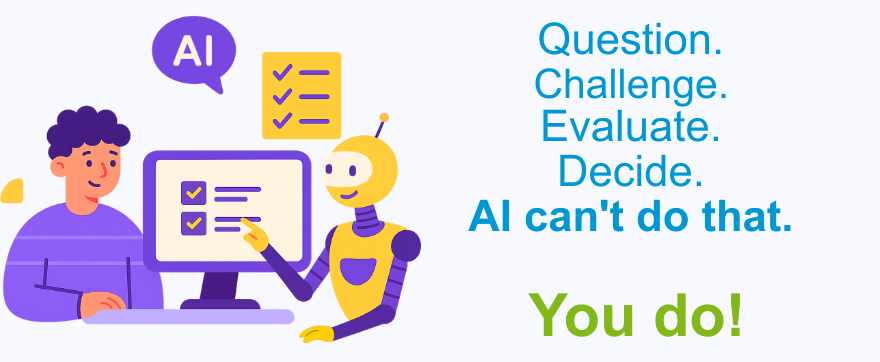
Question. Challenge. Evaluate. Decide. Four things AI can’t do for you.
AI can generate information, recommendations and ideas at extraordinary speed. What it cannot do is the four things that turn a fast answer into a good one.
 Question
AI answers the question it’s given. It doesn’t ask whether that’s the right question in the first place.
If the brief is wrong, the framing is wrong, or the problem has been misdiagnosed, AI will still produce a fluent, confident response to it. Someone has to ask what’s actually being solved here, before asking whether the answer is any good.
 Challenge
AI’s most likely output is its most probable one, the pattern most consistent with what it’s seen before. That’s the opposite of a challenge.
Pushing past that first, most probable answer and asking what else might be true is a deliberately human act. Left unchallenged, the first answer quietly becomes the only answer.
 Evaluate
A fluent answer and a correct one are not the same thing. Evaluating a recommendation means weighing its risks against its benefits, testing its assumptions, and checking it against constraints AI was never given like budget, politics, timing, the history of what’s already been tried.
That’s a judgment call. AI can supply the material for it. It can’t make it.
 Decide

Somebody has to be accountable for what happens next. AI has no stake in the outcome, no consequences to live with, and no responsibility to the people affected by the decision.
Deciding is where all three previous steps have to actually resolve into action and it’s the one step that can never be outsourced.
This is where the two disciplines complement each other. Question and Challenge are largely what Lateral Thinking is built for: pushing past the first answer, disrupting the pattern, generating alternatives before anyone commits to one. Evaluate and Decide are largely what Six Thinking Hats® is built for: giving a group a structured, deliberate way to weigh an answer from every angle before acting on it.
Neither is optional if the goal is a rigorous answer rather than just a fast one.
Critical thinking needs a structure
This is where the conversation can move beyond the vague instruction to “think critically”. Structured thinking approaches such as Six Thinking Hats® and Lateral Thinking give people concrete, repeatable techniques for doing something AI cannot do for them: deliberately structuring the human thinking that happens around an AI output.
Consider a simple example: An AI tool recommends a new customer-retention strategy. The output is polished, persuasive and apparently supported by data.
The easy response is: “This looks good. Let’s implement it.”
A structured thinking process creates a pause.
- What do we actually know?
- What assumptions is the recommendation making?
- What risks or unintended consequences might we be overlooking?
- What opportunities does it reveal?
- What alternatives haven’t we considered?
The point isn’t to make people suspicious of every AI output. It’s to give them a reliable way to interrogate the output before acting on it. That’s an important distinction.
Critical thinking as an aspiration is difficult to measure and easy to forget under pressure. A thinking structure is something people can actually use.
Six Thinking Hats®: structure when you evaluate and decide
Six Thinking Hats® gives teams a shared, deliberate way to examine an idea from different perspectives. That matters when an AI-generated answer already looks polished and complete.
Instead of having the loudest voice in the room decide whether the AI recommendation is good, a team can deliberately shift its attention: establish what is known, explore reactions, identify risks, look for opportunities, generate alternatives and determine what happens next.
The value isn’t simply in asking more questions. It’s in creating a structure that makes those questions happen. That can help prevent a common AI failure mode: everyone agrees with an answer because nobody has been given a reason, or a process, to challenge it.
In that sense, Six Thinking Hats® addresses one half of the problem:
- How do we properly evaluate the answer that’s in front of us?
But there’s another question. What if the answer in front of us shouldn’t have been the starting point in the first place?
Lateral Thinking: structure when you question and challenge
Lateral Thinking addresses the other half of the problem: generating alternatives rather than simply optimising the first idea. That’s particularly relevant when using AI.
AI is designed to respond quickly and fluently to a prompt. If the first answer becomes the starting point for the next prompt, and the next, it’s easy to refine an idea without ever asking whether a fundamentally different idea would be better.
Lateral Thinking gives people techniques for deliberately disrupting that pattern.
The question isn’t simply: “Can AI give us a good answer?”
It’s: “What other answers could we generate?”
That distinction matters because the most dangerous AI output isn’t necessarily an obviously wrong answer. It can be the plausible first answer that nobody thought to challenge.
Together, the two approaches create a useful discipline:
- Lateral Thinking helps us avoid settling for the first answer.
- Six Thinking Hats® helps us examine an answer properly before acting on it.
AI can generate information, recommendations and ideas at extraordinary speed. The human advantage lies in knowing how to question, challenge, create, evaluate and ultimately decide.
Neither approach was built for AI. Both happen to be highly relevant to an AI-enabled workplace because they provide something AI itself cannot provide: a deliberate structure for human thinking.
What this means for you in 2026
If your plan already includes “AI upskilling,” it’s worth asking what’s actually in it. A tool walkthrough can teach people which buttons to press. It can show them how to write a prompt. It can explain what an AI agent does. All of that has value. But none of it necessarily teaches them what to do when the answer comes back. That’s the missing layer.
AI capability isn’t just knowing how to generate an answer. It’s knowing how to evaluate, challenge and improve one. And that capability needs more than an instruction to “use your judgment”. It needs practice. It needs shared language. And, ideally, it needs a structure people can reach for when the pressure is on and the AI-generated answer looks convincing.
Section found that only around one in twenty of the knowledge workers it surveyed met its bar for AI proficiency, while 37.8% had received no AI training at all. The answer isn’t to train everyone to become an AI engineer. It’s to make sure people can use increasingly capable tools without outsourcing their judgment to them. That means developing skills such as:
- Questioning assumptions.
- Distinguishing evidence from interpretation.
- Considering competing perspectives.
- Identifying risks and unintended consequences.
- Generating alternatives.
- Making decisions when information is incomplete.
- Using a repeatable process to challenge an apparently convincing answer.
The first six are thinking skills. The last is what turns those skills into a behaviour.
The next step
Businesses don’t need another report to tell them that AI capability matters. The more useful question is whether businesses are building judgment as fast as they’re buying AI. The evidence suggests there is still a substantial gap.
More people are using AI. More organisations are deploying AI and experimenting with agents. But proficiency, understanding and effective use are not necessarily keeping pace. The answer isn’t to slow down AI adoption. It’s to build the judgment that makes faster adoption worthwhile. And judgment shouldn’t be left to instinct alone.
Give people a structure for challenging AI. Give them a structure for thinking. Because when AI can produce a plausible answer in seconds, the competitive advantage isn’t simply having access to the answer. It’s having people who know what to do with it.
- Attend a public workshop. View the full workshop calendar here.
- Enquire about in-house training. Get in touch to talk about bringing Six Thinking Hats® or Lateral Thinking to your team.
- Training for trainers. Corporate trainers can accredit to deliver Six Thinking Hats® and Lateral Thinking to your people.
Frequently asked questions
Why is critical thinking a top business priority for 2026?
Because AI has made it faster and easier to generate plausible answers, recommendations and content. That increases the value of being able to evaluate those outputs rather than simply accept them.
It’s also the top-ranked capability in the workforce data itself: strategic and critical thinking was selected by 56% of respondents when L&D leaders were asked which capabilities their workforce needs most for 2026.
Does this mean AI is bad for critical thinking?
Not inherently. The issue is what happens when people accept an AI-generated answer simply because it is fast, fluent and complete-looking. AI can support thinking, but people still need to question assumptions, assess evidence and decide whether an output is appropriate for the situation.
A structured thinking process can make that behaviour more consistent.
What’s the difference between AI training and critical thinking training?
AI training typically focuses on how to use a tool: prompting, features, workflows, safety or specific use cases. Critical thinking training focuses on how to evaluate what the tool gives you: questioning assumptions, testing alternatives, assessing evidence and deciding whether an answer should be trusted or acted upon.
The strongest approach is not either/or. People need both the technology skills to use AI and the thinking structure to challenge its output.
Can critical thinking be taught?
Yes. Critical thinking isn’t simply a personality trait. Structured approaches can give people repeatable ways to examine ideas, challenge assumptions, consider alternatives and make better decisions.
Six Thinking Hats® and Lateral Thinking are examples of established approaches that can be applied to modern problems, including the evaluation of AI-generated ideas and recommendations.
Sources
- Together/Absorb, Enterprise L&D in 2026: Trends and Predictions – research showing strategic and critical thinking at 56%, ahead of digital fluency (44%) and leadership skills (42%).
- Section, The AI Proficiency Report, June 2026 – survey of 5,026 U.S. knowledge workers, including findings on AI-agent awareness, AI usage and proficiency.