

 Creative thinking is becoming one of the most important workplace skills for businesses to develop, but many organisations still treat it as an innate ability rather than something employees can learn.
The World Economic Forum’s Future of Jobs Report identifies creative thinking as one of the fastest-growing core skills employers expect to need. That makes creative thinking skills training increasingly relevant to L&D, workforce planning and leadership development. The question for businesses is no longer whether creativity matters. It’s how to develop it systematically.
 Creative thinking is becoming a critical workplace skill
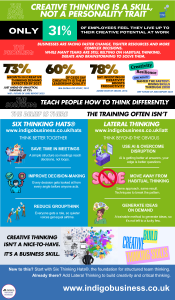
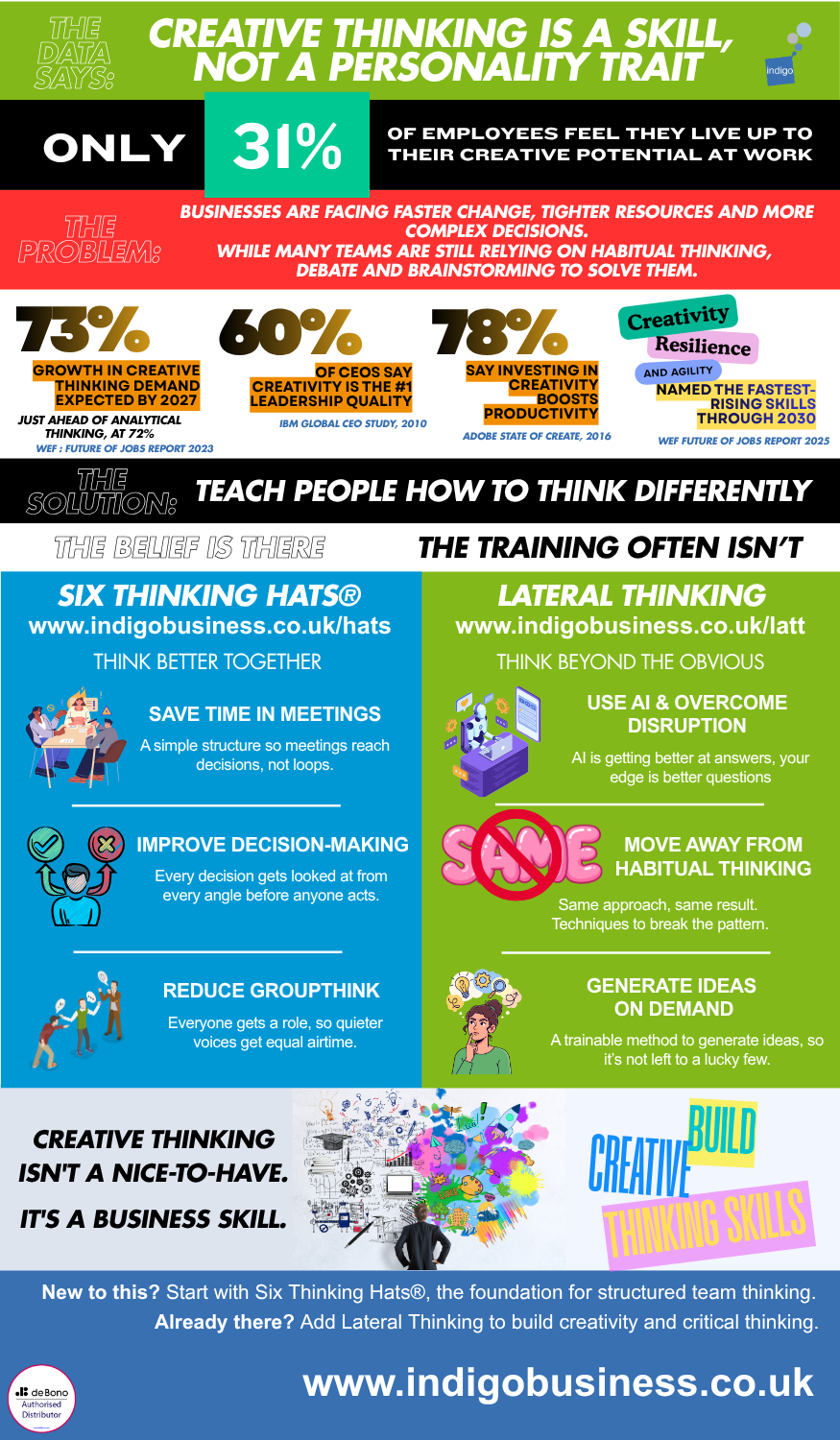
The World Economic Forum’s Future of Jobs Report 2023 found that businesses expect demand for creative thinking to grow by 73% over five years, and analytical thinking by 72% – the fastest-growing core skills between 2023 and 2027. The findings came from a survey of 803 companies, collectively employing more than 11.3 million people across 45 economies.
The report’s findings reflected what businesses expected to need more of as technology, economic uncertainty and changing working practices reshaped the workplace.
The Forum’s more recent Future of Jobs Report 2025 again identifies creative thinking as a skill expected to rise in importance through 2030, alongside capabilities including resilience, flexibility, agility, curiosity and lifelong learning.
There’s a useful way to think about this grouping:
- Creative thinking generates options.
- Resilience helps teams absorb setbacks.
- Agility allows people to adapt and act on what they learn.
As businesses are being reshaped by AI, restructuring and constant change, that combination is increasingly what “keeping up” actually means. And that creates a challenge for organisations: recognising that creative thinking matters is not the same as knowing how to develop it.
The creativity gap isn’t about awareness
The case for workplace creativity isn’t new. In IBM’s 2010 Global CEO Study, 60% of CEOs identified creativity as the most important leadership quality, ahead of integrity and global thinking. The study involved thousands of face-to-face interviews with CEOs across countries and industries.
That finding is now more than 15 years old.
More recent research has continued to point towards the value businesses place on creativity. Adobe’s State of Create research, a nationally representative survey of 5,000 adults across the US, UK, Germany, France and Japan – found that 78% of respondents believed businesses that invest in creativity are more likely to see increased employee productivity, while 70% said being creative makes people better workers.
Yet only 31% felt they were living up to their creative potential at work. The numbers point to an interesting contradiction. People already believe creativity matters. What is often missing is the opportunity, structure and training to practise it.
That’s the real story behind the skills gap headlines. It isn’t necessarily that organisations don’t value creative thinking. Leaders have been saying that they do for years. It’s that many companies have never given their people a repeatable, teachable method for doing it.
Creativity is still too often treated as a personality trait that some people naturally possess and others don’t, rather than as a skill that can be developed through practice – much like negotiation, presentation or communication skills.
Why creative thinking needs a method
This is where structured creative-thinking approaches earn their place. If an organisation simply tells employees to “be more creative”, the instruction is difficult to translate into action. What should someone actually do differently in their next meeting, project or problem-solving session?
A method provides the answer. Structured approaches such as Edward de Bono’s Six Thinking Hats® and Lateral Thinking give individuals and teams practical techniques for deliberately changing how they approach problems, decisions and ideas. Instead of creativity being something people are expected to produce on demand, it becomes something they can practise.
How Six Thinking Hats develops creative thinking
Six Thinking Hats® gives teams a shared language for deliberately switching between different modes of thinking. The framework separates perspectives such as facts, feelings, caution, benefits, creativity and process, allowing a group to focus on one mode of thinking at a time.
That matters because many meetings combine everything at once. Someone raises an idea. Another person immediately criticises it. Someone else introduces a new fact. Another person explains how they feel about it. Before long, the discussion becomes a mixture of ideas, judgement, information and emotion.
Six Thinking Hats® provides a structure for separating those modes.
The result isn’t simply “more creativity”. It’s a more deliberate way of thinking together, one that can help teams explore ideas, identify risks, challenge assumptions and make decisions without getting trapped in the usual patterns of discussion.
How Lateral Thinking develops creative problem-solving
Lateral Thinking addresses a different part of the challenge: how to move beyond the obvious answer. When people encounter a familiar problem, they naturally tend to use established patterns. That’s useful when the existing approach works.
But when the existing approach isn’t working, repeating the same pattern more efficiently isn’t necessarily the answer. Lateral Thinking provides techniques for deliberately disrupting established patterns, challenging assumptions and generating alternatives. That makes it particularly relevant when teams need to:
- find new approaches to persistent problems,
- generate alternatives rather than settle on the first workable idea,
- challenge assumptions that have become invisible,
- identify opportunities competitors may have overlooked,
- rethink products, services or processes, and
- approach unfamiliar problems more flexibly.
Both approaches convert creative thinking from a vague aspiration into a practised capability. And that is precisely the gap the workforce data highlights: high belief in the value of creative thinking, but often far less structured investment in developing it.
What creative thinking training looks like in practice
For organisations, the answer isn’t simply to add “creativity” to a competency framework and move on. Creative thinking skills training works best when people learn practical techniques and then apply them to real work. There are three useful steps:
- Treat creative thinking as a skill, not a personality trait – If creative thinking matters to your organisation, make it explicit. Include it in capability frameworks, leadership development, workforce planning and learning programmes rather than assuming that creative employees will simply emerge when needed.
- Give teams a shared creative-thinking process – Teams need more than encouragement to “think outside the box”. Training in structured approaches such as Six Thinking Hats® and Lateral Thinking gives employees techniques they can use in meetings, problem-solving, decision-making and innovation. A shared method also means creativity doesn’t depend entirely on having one naturally creative person in the room.
- Practise on real business challenges – Creative thinking becomes much more valuable when people apply it to genuine challenges. That could mean using creative-thinking techniques to explore a customer problem, rethink a process, generate new product ideas, address an operational challenge or find alternatives to an established approach.
The aim isn’t to make people “more creative” in the abstract. It’s to make creative thinking something they can actually use.
 What this means for L&D and workforce planning
If your workforce planning or L&D priorities already mention adaptability, innovation, problem-solving or the skills gap, creative thinking deserves a specific line item – not just a passing mention.
The organisations that build a repeatable creative-thinking capability now, while many competitors are still treating creativity as an innate trait, will be better positioned to respond when the next disruption arrives. That disruption may be AI-driven. It may be economic. It may come from a new competitor, changing customer expectations or an unexpected shift in the market. The specific disruption is difficult to predict.
The ability to think differently when it happens is something organisations can develop now. And this is where creative thinking skills training becomes more than another item on an L&D catalogue.
It is a way of building organisational capability.
The next step: make creative thinking a capability
The data suggests that creative thinking is becoming increasingly important to businesses. The challenge now is turning that recognition into action.
Organisations don’t need to wait for the next skills audit to tell them that employees need to become more adaptable, innovative and capable of solving unfamiliar problems. They can start by giving people practical ways to think differently now.
That’s the purpose of structured creative thinking training: turning creativity from an aspiration into a skill that people can practise, apply and develop.
Get in touch to talk about bringing Six Thinking Hats® or Lateral Thinking to your team.
Frequently asked questions about creative thinking skills training
What is creative thinking skills training?
Creative thinking skills training teaches individuals and teams structured techniques for generating ideas, challenging assumptions, exploring alternatives and approaching problems from different perspectives. Rather than relying on creativity as an innate personality trait, training gives people repeatable methods they can practise and apply to real workplace challenges.
Why is creative thinking important in the workplace?
Creative thinking helps employees generate alternatives, solve unfamiliar problems, challenge established assumptions and identify new opportunities. It is particularly valuable when organisations face changing markets, new technologies, complex problems or situations where established approaches are no longer sufficient.
Can creative thinking be taught?
Yes. While people naturally differ in their experiences, preferences and ways of thinking, structured creative-thinking techniques can be learned and practised. Approaches such as Six Thinking Hats® and Lateral Thinking provide repeatable methods that individuals and teams can use to develop and apply creative thinking.
What is Six Thinking Hats®?
Six Thinking Hats® is Edward de Bono’s parallel-thinking framework. It helps teams deliberately examine an issue from different perspectives rather than mixing facts, criticism, ideas and emotions into one discussion. The approach gives teams a shared language for thinking together more productively.
What is Lateral Thinking?
Lateral Thinking is Edward de Bono’s approach to deliberately changing established patterns of thought in order to generate new possibilities and alternatives. It provides techniques for challenging assumptions, escaping habitual thinking patterns and finding approaches beyond the obvious first answer.
Sources
- World Economic Forum, Future of Jobs Report 2025 (digest)
- World Economic Forum, “Future of Jobs: These are the most in-demand core skills in 2023”
- World Economic Forum press release, “Future of Jobs Report 2023: Up to a Quarter of Jobs Expected to Change in Next Five Years” (survey sample: 803 companies, 11.3 million workers, 45 economies)
- World Economic Forum, Future of Jobs Report 2025 — Skills Outlook
- IBM, “Capitalizing on Complexity: Insights from the Global Chief Executive Officer Study” (2010)
- Adobe Blog, “Creativity Drives Business Success — Key Takeaways From the 2016 State of Create Report”