
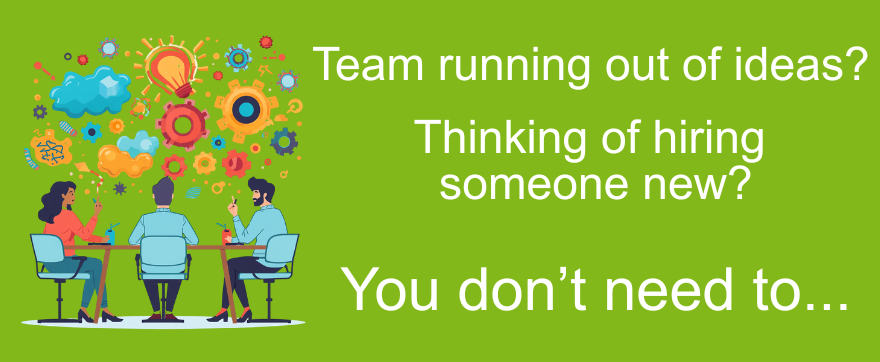
 The instinct is understandable. A team’s creative output is disappointing, so the plan becomes: hire someone more creative.
It rarely solves the underlying problem, and even when it works, it doesn’t scale. One new hire doesn’t fix a team; it just adds another name to the list of people everyone else defers to.
The businesses that solve this problem stop trying to buy their way out of it. They build a creative thinking process instead: a repeatable way to generate ideas, develop them and decide which ones are worth pursuing.
Why hiring doesn’t fix this
Hiring for creativity treats the problem as a headcount gap. But the actual gap is usually structural: no shared technique for generating ideas, no shared way of deciding which ones are worth pursuing, and no permission for anyone outside the “creative” few to contribute one.
A new hire, however talented, walks into that same structure. Within a few months, they’re either absorbed into the same pattern everyone else follows, or they become yet another bottleneck – the person every idea has to pass through before anyone takes it seriously.
Neither outcome fixes the underlying issue. The team still has no repeatable way to generate more ideas or evaluate them properly. It’s just relying on one more person to carry the whole function personally.
Demand for creative thinking is rising. The World Economic Forum’s Future of Jobs Report 2023 identified creative thinking as one of the skills expected to increase in importance over the following five years.
A hiring strategy that adds one person at a time was never going to keep pace with a capability that more and more people across an organisation need to use.
What a process actually replaces
A creative thinking process does two jobs that hiring can’t: it gives everyone a technique, not just the naturally confident, and it separates generating ideas from judging them, so good ideas don’t get killed in the first thirty seconds by whoever’s most senior in the room.
Without that separation, most “creative” discussions quietly turn into a filtering exercise before anyone has actually generated anything worth filtering. The first idea gets picked apart, the room gets cautious, and the second and third ideas, usually the more interesting ones never get voiced at all.
A structured process fixes the sequencing. Generate first, in volume, without judgment. Evaluate second, deliberately, with everyone’s input rather than one person’s gut reaction. That distinction is at the heart of a repeatable creative thinking process.
Lateral Thinking: the technique for generating more
This is the first half of the process, and it’s what Lateral Thinking training gives a team: specific, repeatable techniques for deliberately moving beyond the first, most obvious answer. It works because it doesn’t rely on any one person having a flash of inspiration. It gives everyone a method – deliberately challenging assumptions, generating provocations, building on ideas rather than dismissing them early – that produces more raw material regardless of who’s in the room.
More raw material matters. The first answer to most business problems is rarely the best one. It’s just the one that got there first and didn’t get challenged. Lateral Thinking gives a team a way to challenge that first answer instead of automatically settling for it.
Six Thinking Hats®: the structure for evaluating ideas
Generating more ideas creates a new problem if nothing else changes: now there’s more to evaluate, and the same unstructured discussion that used to kill one idea too early will just as happily kill five.
This is where Six Thinking Hats® training comes in. It gives the team a shared, deliberate way to examine an idea from multiple angles: facts, feelings, risks, benefits and possibilities, managed by an overall process – before deciding what to do next. Nobody’s default instinct, whether that’s risk-aversion, optimism or simply whoever talks fastest, gets to dominate the whole conversation by default.
The value isn’t just that there are more perspectives. It’s that the team considers those perspectives deliberately rather than having them collide randomly in the same conversation.
Put together, the two techniques cover the whole process: Lateral Thinking to generate more and better options; Six Thinking Hats® to examine those options properly.
Neither one, on its own, is the whole answer.
What this looks like in practice
A team using this process doesn’t look meaningfully different in headcount. It looks different in output, because the same people are now working with a shared technique instead of leaning on whoever happens to be “the creative one” that week.
Ideas get generated in volume rather than waited for. They get examined properly rather than approved or killed on instinct.
And critically, the process doesn’t depend on any single person being present. It can be used when someone is on leave, changes roles or leaves the business entirely.
The capability shouldn’t leave the business when one person does.
The next step
If the plan for improving your team’s creative output currently involves waiting for the right hire, it’s worth asking what would change if that hire never showed up.
A structured creative thinking process doesn’t have that dependency. It’s trainable, repeatable, and it scales to however many people actually need to use it, not just the few who already do.
The goal isn’t to find the one person who can make the team more creative. It’s to make creative thinking something the whole team can do.
- Attend a public workshop. View the full workshop calendar here.
- Enquire about in-house training. Get in touch to talk about bringing Six Thinking Hats® or Lateral Thinking to your team.
- Training for trainers. Corporate trainers can accredit to deliver Six Thinking Hats® and Lateral Thinking to your people.
Frequently asked questions
Why doesn’t hiring more creative people solve a team’s creativity problem?
Hiring adds one person to an unchanged structure. If the team has no shared technique for generating ideas and no shared way of evaluating them, a new hire either gets absorbed into that pattern or becomes a new bottleneck. Neither builds a repeatable capability the rest of the team can use.
What does a creative thinking process actually involve?
At minimum, two things: a technique for generating a high volume of ideas without judging them too early, and a structured way to evaluate those ideas afterwards so a good one doesn’t get dismissed because of who’s in the room or how it’s first received.
How is this different from a brainstorming session?
A brainstorming session is usually a single event with no shared technique behind it. A creative thinking process gives people specific, repeatable methods, such as Lateral Thinking for generating alternatives and Six Thinking Hats® for structured evaluation, that they can keep using long after the session ends.
Does this work for teams that don’t see themselves as creative?
It’s built for exactly those teams. The techniques don’t depend on natural creative confidence, they give people a specific method to follow, which is usually what’s missing rather than the underlying ability.
Sources