
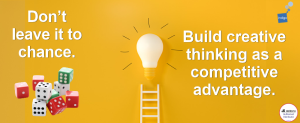
 Every business seeks an edge, yet creative thinking as a competitive advantage is often overlooked. Many invest in new technology, new hires, consultants and products. Meanwhile, creative thinking may already sit within their workforce.
The problem is that most organisations leave this capability to chance.
Creative thinking means generating ideas, challenging assumptions and exploring alternatives before deciding what to do. People can develop these skills, but they need practical techniques and opportunities to apply them.
Creative thinking training gives organisations a way to build those skills across their existing workforce.
Employers are paying attention. The World Economic Forum’s Future of Jobs Report 2025 ranks creative thinking fourth among the core skills employers say their workforces need today. It also identifies creative thinking as a skill expected to grow in importance towards 2030.
Creative thinking as a competitive advantage: what you gain
Competitors can buy similar software, recruit from the same talent pool and compete on price. Developing the way your people think together gives you another way to stand out.
- More options before committing. Explore alternatives rather than settling for the first workable answer.
- Decisions that have been properly examined. Consider different perspectives, potential benefits and risks before deciding what to do.
- A more consistent approach to problem-solving. Give people shared techniques instead of relying on familiar responses or repeatedly revisiting the same arguments.
- More flexible responses to change. Question assumptions and explore alternatives when markets, customer expectations or technology shift.
This matters even more as AI becomes commonplace. Producing ideas is becoming easier, but generating options is only part of the process. People still need to challenge suggestions, develop promising possibilities and decide which ones are worth pursuing.
We explore this in AI can give you lots of ideas. Challenge, develop and pick the right one with Lateral Thinking and Question. Challenge. Evaluate. Decide. AI can’t do that.
Creative thinking as a competitive advantage: why it costs less than you think
Competitive advantage often requires investment in technology, recruitment or external expertise. Creative thinking training is another option: it develops the capabilities of people you already employ and gives them techniques they can apply across different challenges.
- It develops the people you already have. Equip existing employees with practical techniques for thinking through challenges, rather than relying solely on finding the right new hire.
- The skills have multiple applications. The same techniques can be used across projects, meetings, planning and decision-making, rather than being tied to one specific problem.
- It works across departments. Creative thinking is relevant to sales, operations, management, service delivery and strategy. A shared approach can help people apply the skills in different contexts.
- It can help reduce avoidable waste. Examining alternatives before committing to a decision can help teams identify weaknesses earlier and avoid pursuing ideas that haven’t been properly considered.
The value comes from developing skills that people can use repeatedly, rather than buying a solution for just one challenge. The return depends on how well the techniques are applied and reinforced.
We’ve also explored why relying on one creative individual isn’t enough in Stop waiting for creative people. Start building creative skills. When more people develop the skills, the organisation becomes less dependent on a handful of individuals to generate ideas.
So why do so few organisations use it?
If creative thinking can make such a difference, why is it so rarely developed deliberately? Several assumptions get in the way.
- “Some people are just creative.” Creative thinking is often treated as an innate talent. In practice, people can learn techniques for generating ideas, challenging assumptions and exploring alternatives.
- “We run the occasional brainstorm.” A one-off session can be energising, but it doesn’t necessarily change how people approach problems afterwards.
- “It’s nobody’s job.” Creative thinking matters across departments, yet responsibility for developing it can fall between teams.
- “We can’t measure it.” Creative thinking can be harder to measure than sales or productivity, but organisations can assess whether teams explore alternatives, examine problems thoroughly and explain the reasoning behind decisions.
Often the missing piece is a practical method people can use consistently, not a lack of creative people.
What building this advantage looks like
Developing creative thinking across a team doesn’t need to start with a major programme. It needs practical techniques, opportunities to practise and a reason to use them.
- Teach practical techniques. Lateral Thinking helps people generate ideas and challenge assumptions. Six Thinking Hats® gives teams a structured way to examine issues from different perspectives.
- Use real business challenges. Give people opportunities to practise the techniques on problems they recognise from their own work.
- Create a shared approach. When a team learns the same methods, members can use them together rather than relying on individual preferences.
- Reinforce the learning. Encourage people to use the techniques in meetings, planning sessions and everyday problem-solving so they become familiar tools rather than one-off workshop exercises.
Lateral Thinking and Six Thinking Hats® complement each other by supporting different parts of the thinking process. Read Six Thinking Hats® and Lateral Thinking: why they work best together to explore how the two approaches work together.
For a closer look at the practical benefits, read Creative thinking is a skill you can learn. Here’s what training changes. Our overview of Creative thinking skills training explores the wider case for developing these capabilities.
ABOUT INDIGO AND EDWARD DE BONO
Indigo Business Services is the exclusive UK distributor for Edward de Bono Limited. We run the full suite of de Bono creative thinking workshops, including Lateral Thinking, Six Thinking Hats® and Course in Creativity™, helping teams generate better ideas and make stronger decisions.
Frequently asked questions
Is creative thinking as a competitive advantage realistic?
Yes. Creative thinking can help organisations generate alternatives, examine problems from different perspectives and make more considered decisions. The advantage comes from developing these skills across a team and applying them consistently, rather than relying on a few individuals to come up with good ideas.
Why describe creative thinking as a low-cost competitive advantage?
It builds on people you already employ and develops skills that can be applied across different work situations. Training offers a way to develop existing capabilities, although the cost and return will depend on the programme, how the skills are applied and how well the learning is reinforced.
How long before we see results?
Participants can start applying techniques during a workshop and in subsequent work situations. Broader changes in how a team approaches problems develop as people practise the techniques, use them on real challenges and reinforce what they’ve learned.
Does creative thinking matter in the age of AI?
Yes. AI can help generate ideas and suggest possible solutions, but its output still needs to be evaluated in context. People need to question assumptions, explore alternatives and exercise judgement when deciding what to use. Creative and critical thinking skills help them do that more effectively.
Which creative thinking course should we start with?
It depends on your objectives. Lateral Thinking focuses on generating ideas and challenging assumptions. Six Thinking Hats® helps people examine issues from different perspectives and make more considered decisions. The Course in Creativity™ combines both approaches in one programme.
Stop leaving creative thinking to chance
Your people are already solving problems, making decisions and looking for better ways to work. Give them practical techniques to generate more ideas, challenge assumptions and make more considered decisions.
The Course in Creativity™ combines Lateral Thinking and Six Thinking Hats® to develop both idea generation and structured decision-making.
- Course in Creativity™: Explore the programme and dates
- Lateral Thinking: View public workshops
- Six Thinking Hats®: View public workshops
- Training your team: Explore in-house options
Most businesses leave creative thinking to chance. You don’t have to.