
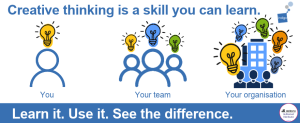
 Most organisations want more creative thinking, but far fewer train their people to do it. Which leads to faimilar results: the same few people supply the ideas, the first workable suggestion wins, and decisions can end up being shaped by whoever argues most convincingly.
Creative thinking training gives people practical techniques to generate ideas, challenge assumptions and explore alternatives. Rather than relying on inspiration or individual talent, people learn a structured approach they can practise and apply to real workplace challenges.
So what does effective creative thinking training actually change for individuals, teams and the wider organisation?
What good creative thinking training looks like
A one-off brainstorm or an inspirational talk can feel energising, but it doesn’t necessarily change how people work the following Monday. Effective creative thinking training gives people something they can continue to use long after the workshop ends.
Three things make the difference.
- A method, not a mood. People learn specific techniques for generating ideas and a clear structure for working through them, rather than waiting for inspiration to strike.
- Practice on real challenges. Techniques become easier to apply when people practise them on problems they actually face at work.
- A shared language. When a whole team learns the same approach, people can work through challenges together without having to establish a new process every time.
This is also why hiring one creative person rarely transforms an entire team. We explore the reasons in ‘One hire won’t make your team more creative‘. Training gives more people the techniques to contribute, reducing reliance on a small number of confident idea-generators.
What changes for you
For individuals, one of the biggest benefits is having a starting point when an idea doesn’t come easily. Creative thinking becomes less dependent on inspiration and more about knowing how to approach a problem.
- Ideas on demand. Deliberate techniques give you somewhere to start when you’re stuck, rather than leaving you waiting for a flash of inspiration.
- A way past the first answer. You learn to challenge assumptions and explore alternatives before settling on the obvious option. Our guide to Lateral Thinking explains how structured techniques can help.
- Rough ideas that become usable. A half-formed suggestion can be developed into something worth exploring instead of being dismissed before its potential is understood.
- More confidence in meetings. Having a method to work through a problem can make it easier to contribute ideas, question assumptions and explain your thinking.
People don’t become endlessly creative overnight, but they gain practical ways to move forward when the answer isn’t obvious.
What changes for your team
When a team shares a method for thinking through problems, meetings can become more productive. Instead of competing to defend individual opinions, people have a structure for exploring an issue together.
- Less unproductive arguing. With Six Thinking Hats®, teams can examine an issue from different perspectives in a structured way, helping people explore the problem rather than simply defend their own positions.
- More voices heard. A shared process creates opportunities for people with different communication styles and levels of confidence to contribute, rather than allowing the most vocal participants to dominate.
- Ideas developed before they are judged. Giving suggestions room to develop before evaluating them can help teams recognise potential they might otherwise overlook.
- More considered decisions. When people examine alternatives, potential benefits and risks, they have a stronger basis for agreeing on a way forward.
These changes don’t happen automatically after one workshop. They develop as people use the techniques in their everyday work.
What changes for your organisation
When creative thinking skills are developed across a business, the benefits can extend beyond individual workshops or teams.
- Better-examined decisions. Teams have practical ways to consider risks, benefits and alternatives before committing to a course of action.
- Less reliance on a few individuals. Creative thinking becomes a capability more people can contribute to, rather than something expected from a handful of naturally inventive employees.
- A common approach across departments. People from different functions can use shared techniques to explore problems, develop options and work towards solutions, rather than starting from scratch each time.
The aim is to give people practical skills they can draw on when they need to solve problems, improve processes or find a different way forward.
If you’re considering how to develop these capabilities, our overview of creative thinking skills training explains why employers invest in these skills.
Why idea generation and decision-making work best together
Generating ideas without a way to assess them can leave you with a long list and no clear decision. Making decisions without generating fresh ideas can leave you choosing between the same familiar options.
Effective creative thinking brings the two together: generate possibilities, explore them properly and decide which options are worth pursuing.
That’s why Lateral Thinking and Six Thinking Hats® complement each other. Lateral Thinking helps people generate alternatives and challenge established patterns, while Six Thinking Hats® provides a structured way to examine an issue from different perspectives.
We explain the relationship in Six Thinking Hats® and Lateral Thinking: why they work best together.
ABOUT INDIGO AND EDWARD DE BONO
Indigo Business Services is the exclusive UK distributor for Edward de Bono Limited. We run the full suite of de Bono creative thinking workshops, including Lateral Thinking, Six Thinking Hats® and Course in Creativity™, helping teams generate better ideas and make stronger decisions.
Frequently asked questions
Does creative thinking training really work?
Creative thinking training can help people develop practical techniques for generating ideas, challenging assumptions and exploring alternatives. Its value depends on the quality of the training, opportunities to practise and whether people apply the techniques to real work.
How long does it take to see a difference?
Participants can start applying techniques during a workshop and in subsequent work situations. Developing consistent habits across a team takes practice, reinforcement and opportunities to use the techniques on real challenges.
Should we train individuals or a whole team?
Both approaches have benefits. Individuals can develop techniques they use in their own work, while training a whole team creates a shared language and approach that people can use together. The right option depends on your objectives and the challenges you want to address.
Do people need to be creative to benefit from training?
No. Creative thinking training is not just for people who already consider themselves creative. Practical techniques give people structured ways to approach problems, generate alternatives and develop ideas, regardless of whether creativity comes naturally to them.
What should creative thinking training include?
Effective creative thinking training should teach practical techniques, give participants opportunities to practise them and show them how to apply the techniques to real workplace challenges. For teams, a shared approach can help people generate alternatives and examine ideas more systematically.
Which creative thinking course should we choose?
It depends on what you want to achieve. Lateral Thinking focuses on generating ideas and challenging established patterns. Six Thinking Hats® helps people explore issues from different perspectives and improve decision-making. The Course in Creativity™ brings both approaches together in one programme.
Develop creative thinking across your team
Creative thinking shouldn’t depend on who happens to have a good idea. Give your people practical techniques to generate alternatives, challenge assumptions and examine ideas before deciding what to do next.
The Course in Creativity™ combines Lateral Thinking and Six Thinking Hats® to develop both idea generation and structured decision-making.
- Course in Creativity™: Explore the programme and dates
- Lateral Thinking: View public workshops
- Six Thinking Hats®: View public workshops
- Training your team: Explore in-house options
Give your people a method and creative thinking stops being left to chance.